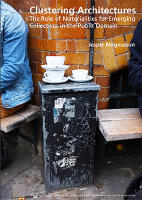

Clustering Architectures : The role of materialities for emerging collectives in the public domain
Häftad bok. Department of Architecture and Built Environment. 2016. 295 sidor.
Gott skick.
Inrikes enhetsfrakt Sverige: 62 SEK
Förlagsfakta
- ISBN
- 9789162898885
- Titel
- Clustering Architectures
- Undertitel
- The role of materialities for emerging collectives in the public domain
- Författare
- Magnusson, Jesper
- Förlag
- Department of Architecture and Built Environment
- Utgivningsår
- 2016
- Omfång
- 295 sidor
- Bandtyp
- Häftad
- Mått
- 0 x 240 mm Ryggbredd 18 mm
- Vikt
- 655 g
- Språk
- English
- Baksidestext
- How can material design facilitate humans’ co-existence in shared urban space? This thesis is a study of public social life, addressing issues about how and by what means people meet and cluster in urban domains. The overarching concern is how materialities may contribute to a more inclusive and multifarious public life. A series of empirical investigations were completed as field studies of a selection of public spaces, primarily in London, Amsterdam and Paris. Based on the empirical findings, a number of concepts are developed and determined effective as tools for the analysis of public life, as well as for providing operative approaches to urban design practices. As tools for inquiry and analysis, the concepts all aim towards an understanding of spatial production as the effects of heterogeneous clusterings. These conceptual tools suggest a particular attention to artefacts and architecture as significant social mediators, potentially facilitating encounters and exchanges between strangers. The concepts introduced in this book are intended to contribute to a relational and processual exploration of how the material may co-produce social life, and how materialities can possibly be seen as supporting the stabilisation of emergent collectives. In this thesis, I have striven to show that the design and distribution of certain materialities have major strategic implications for questions concerning co-existence, communality and collaboration in public domains.
Department of Architecture and Built Environment
9789162898885