

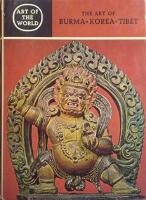
Art of the World : Burma, Korea, Tibet (Art of the World Series)
Inbunden bok. Methurn,London. 1968. 277 sidor.
Nyskick.
This superb addition to the Art of the World series deals with the art and cultures of three Asian centers whose history and development have been traced only in recent years. The three authors, through their research and excavations, played a significant part in disclosing the artistic achievements of these cultures, so long unknown to the rest of the world.
Noteworthy Burmese art began at approximately 500 A.D. during the Mon period, when the first kingdoms were created and the influence of Indian Gupta art spread in their courts. The peak of Burmese art was reached during the Pagan period, about 1,000 A.D., when a completely independent style developed and mighty temples were built. At the end of the Pagan period artistic achievement began to decline, experiencing a short renaissance during the fifteenth and sixteenth centuries.
The development of Korean art began in the three rival kingdoms of Koguryo, Paeksche and Silla during the second to sixth centuries. The finest art was produced during the seventh century after the union of the three kingdoms. Chinese culture influenced Korea strongly, and Korea in turn passed this on to Japan, thereby becoming an important link in the artistic development of the entire Far East.
The culture of Tibet, on the other hand, developed quite late; its finest works were produced during the sixteenth to nineteenth centuries. The paramount influence was that of Tibet's theocratic government; the artist was required to create objects to meet ritualistic needs rater than respond to his own unhampered creative impulses. Nevertheless, artistic works of the highest level were produced in spite of the restrictions imposed by rigid rules.
Rikt fotoillustrerad i färg. 23,5x18,2 cm. Engelska. Box.Nyskick. (250619)




![Det sjungande trädet : [Grünewald 1889-1989] : Liljevalchs konsthall 8 sept-5 nov 1989, Norrköpings konstmuseum 19 nov 1989-28 jan 1990, Borås konstmuseum 11 febr-8 april 1990](https://dez1v4fbcawql.cloudfront.net/product/873921/7497481/5a82f893bed5e.jpg)


