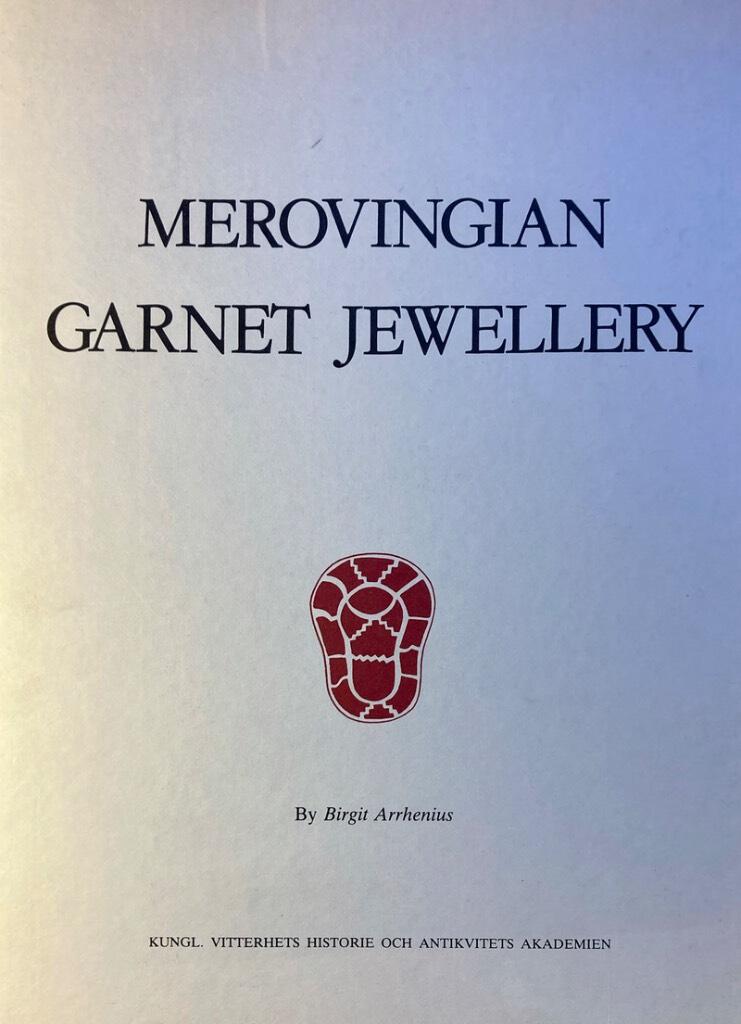
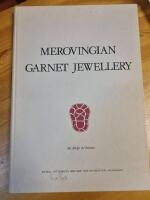
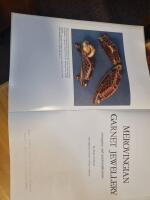
Merovingian garnet jewellery : Emergence and social implications
Inbunden bok. Kungl. Vitterhetsakademien. 1985. 229 sidor.
Mycket gott skick. Skyddsomslag i nära nyskick.
This book deals with different aspects of Merovingian garnet jewellery. The work is based on diffraction analyses of garnets and cements and on a study of technical elements in cloisonné settings. The origins of the garnets are discussed in chapter 1. Three sources for garnets with different physical qualities are recognized in the Merovingian material, two in Central Europe (in Bohemia and possibly in South-West Austria) and the third in the Black Sea area. Indian garnets, which were used mostly for intaglios in the Hellenistic period, are not found in this material. This may be explained by the necessity to use garnets which can be cleaved to produce thin, flat plates in cloisonné work. The different shapes into which garnets are cut are described in chapter 2. It is proposed that the cutting was carried out with a high-speed wheel. Chapter 3 lists the cements and sand putties used in cloisonné work. In chapter 4 the prerequisite conditions which indicate a cloisonné workshop are discussed and a hypothetical system comprising a central workshop with satellite workshops is presented. In the central workshop garnets are cut from templets and are often assembled into emblemata; objects of the highest quality, often with royal associations (such as the Childeric finds) are made in these workshops. Cut garnets and emblemata are imported to the satellite workshops where they are mounted in single, locally made objects. A central workshop situated in Constantinople is proposed as the source of cloisonné objects made in the cement technique with satellite workshops in Hungary and the Rheinland. Chapter 5 and 6 describe cloisonné jewellery made in the Merovingian Empire in the sixth century. The different types of sand putty used in these works allow several workshops to be recognized. It is proposed that a central workshop. characterized by garnets which were probably brought from Bohemia and were usually cut from f-St and g-St templets, was situated in Trier. Its satellite workshops were located in the Rheinland, the Upper Danube region, the North Sea area, Anglo-Saxon Kent as well as in Scandinavia. The organization of Merovingian workshops is discussed in chapter 7. The importance of cloisonné jewellery as gifts at a royal level or on the occasion of exogamy is analysed and the implications of this for the distribution of garnet cloisonné outside the Merovingian Empire is discussed.
Assistant professor Birgit Arrhenius, Arch. research laboratory, University of Stockholm,
S-106 91 Stockholm, Sweden
Birgit Arrhenius 1985 ISBN 91-7402-160-5
Printed in Sweden 1985 by Graphic Systems, Göteborg

Förlagsfakta
- ISBN
- 9789174021608
- Titel
- Merovingian garnet jewellery : Emergence and social implications
- Författare
- Birgit Arrhenius
- Förlag
- Kungl. Vitterhetsakademien
- Utgivningsår
- 1985
- Omfång
- 229 sidor
- Bandtyp
- Inbunden
- Vikt
- 1015 g
- Språk
- English