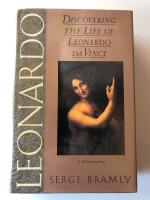
Leonardo: Discovering the Life of Leonardo Da Vinci
Inbunden bok. Edward Burlingame Boooks. 1991. 493 sidor.
Mycket gott skick. Skyddsomslag i mycket gott skick. Oläst exemplar. Namnteckning på försättsblad. Recreates the life and times of Leonardo da Vinci, capturing his insecurities about his place in society and describing his ferocious desire to understand the mysteries of the universe. An "impeccable dandy," charming, brilliant and strikingly handsome da Vinci (1452-1519) emerges in this fresh, gripping portrait as a genius torn by inner conflicts. The polymath artist/engineer/scientist was an illegitimate child traumatized by separation from his loving mother, writes Bramly, biographer of Man Ray. Analyzing Leonardo's notebooks and annotated erotic drawings, as well as contemporary sources, the author depicts the Renaissance prodigy as a man who felt rejected by his father, ambivalent about his homosexuality and both curious about and disgusted by male-female sex. Though vehemently anticlerical, Leonardo believed in God--indeed, was almost jealous of the Creator, whom he called "inventor of everything." Bramly has dusted off the primary sources to make da Vinci a startlingly prescient, relevant figure in this exceptional biography. While there is no lack of scholarship about the protean genius of da Vinci, this competent biographical treatment can nevertheless be welcomed. Bramly neither seriously elucidates the core elements of da Vinci's scientific and technological concerns nor profoundly illuminates the formal nature of his artistic achievement, but this chronologically structured survey is not without its introductory value. The necessarily frustrating recitation of da Vinci's brilliantly conceived but unfinished or aborted projects is neatly set within the context of contemporary patronage. The central mysteries of this well-documented yet enigmatic personality are suggested without the author's acquiescing to the allure of facile pscyhologizing. But though serviceable, this introduction would have benefited from a more extensive scrutiny of da Vincian literature and a greater appreciation of the impact of the artist's limited oeuvre on the history of art.