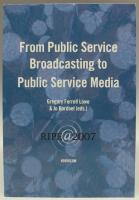
From Public Service Broadcasting to Public Service Media
Häftad bok. Nordicom. 2007. 259 sidor.
Mycket gott skick.
ENGELSK TEXT. Format 24 x 16,5 cm Vikt 485 g.
Häftad bok med mjuka pärmar. Boken hör till RIPE-serien. CONTENTS: Preface. PSM platforms: policy & strategy. PSM programmes: stategy & tactics. The roots of PSM. Author biographies.
// Inga anteckningar, pärmarna har mindre hanteringsspår. Bilden avser den aktuella boken. Utnyttja gärna inrikes ENHETSFRAKTEN, samma fraktpris oavsett hur många böcker du beställer samtidigt av Boklöf [1931]

Förlagsfakta
- ISBN
- 9789189471535
- Titel
- From public service broadcasting to public service media
- Författare
- Lowe, Gregory Ferrell - Bardoel, Jo - NORDICOM
- Förlag
- Nordicom
- Utgivningsår
- 2007
- Omfång
- 259 sidor
- Bandtyp
- Häftad
- Mått
- 164 x 242 mm Ryggbredd 15 mm
- Vikt
- 480 g
- Språk
- English
- Baksidestext
- The core challenge facing public service broadcasting today is the transition to public service media. This understanding characterised discourse among participants in the RIPE@2006 conference in the Netherlands, the theme of which was Public Service Broadcasting in the Multimedia Environment: Programmes and Platforms. The contributors in this volume focus attention on issues of strategic concern and tactical importance in addressing the core challenge. A defining theme is the need for moving beyond the transmission model of broadcasting to mature both professional and theoretical thinking necessary in public service communication. Audiences must be understood as partners rather than targets and content that is cross-media and cross-genre must be popular but remain distinctive. For policy makers the core challenge necessitates fairly balancing the often contrary interests of commerce and culture which is a fundamental tension in media policy today. The stakes are high because policy and operational decisions will establish the character of the European dual media system for decades to come. What is the mission of public service media in a multimedia environment characterised by globalization, convergence, digitization, and fragmentation? What is important for strategy development that renews the public service enterprise while keeping faith with the ethos that legitimates the endeavour? How might policy makers variously understand the fuller possibilities entailed in the development of a uniquely European dual media system?