

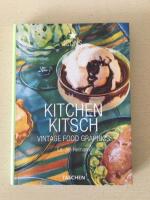
Kitchen kitsch : vintage food graphics
Häftad bok. Köln ; London : Taschen. 2002.
Nära nyskick.
Introduktion på engelska tyska och franska.
Två sidor vikta i inlagan sen tryckningen, i övrigt i nyskick!
The lady of the house was the object of much attention by American advertisers for almost all of the twentieth century. Sequestered at home, her typical domestic duties included child rearing, cleaning, ironing, shopping and, above all, providing meals for all members of the household, The kitchen was her domain and it was here that Aunt Jemima®, Jell-O®, Weber® and Velveta® courted her attention and brand loyalty.
From the very start of the century, food companies recognized the value of providing homemakers with free booklets espousing products and providing recipes for using them. So successful were these premiums that they became fixtures in every housewife's kitchen as food companies produced them en masse. Almost every American company offering items that would find their way into the kitchen produced a booklet of some sort. Sardines, dates, flour, cheese, beef, whipped cream, rice, potatoes - you name it and there was a pamphlet extolling its virtues.
By far the most common means of distribution was through the mail. An advertisement placed in a women's magazine became the initial contact. By sending in the coupon, the lucky homemaker would find a booklet rushed to her mailbox. Recipe booklets could also be included in the packaging
or attached to the product itself.
The illustrations contained in many of the booklets were especially fine examples of their oeuvre and a primary factor in their appeal to collectors. While most were the product of anonymous commercial artists and illustrators, there were some exceptions, such as several done for Jell-O® by Max-
field Parrish. The period prior to mid-century was particularly rich in showcasing a commercial artist's ability to portray the food and products in a highly stylized manner. Produced by masters of color and composition, these illustrations romanced their audience with tantalizing visions of the culinary art.
Often the artistic interpretations were hard to duplicate in the kitchen, but the visual appeal was the great seducer. Early attempts at food photography were less successful, but eventually, as technology improved, it became the dominant medium for most of the brochures after the 1950s.

Förlagsfakta
- ISBN
- 9783822814963
- Titel
- Kitchen kitsch : vintage food graphics
- Författare
- Heimann, Jim
- Förlag
- Köln ; London : Taschen
- Språk
- English


