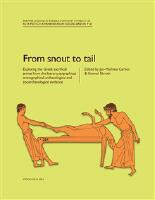
From snout to tail. Exploring the Greek sacrificial animal from the literary, epigraphical, iconographical, archaeological, and zooarchaeological evidence
Inbunden bok. Publikationsnämnden vid de Svenska Instituten vid Rom och Athen. 1 uppl. 2024. 270 sidor.
Nyskick. Skyddsomslag i nyskick. Animal sacrifice fundamentally informed how the ancient Greeks defined themselves, their relation to the divine, and the structure of their society. Adopting an explicitly cross-disciplinary perspective, the present volume explores the practical execution and complex meaning of animal sacrifice within ancient Greek religion (c. 1000 BC–AD 200). The objective is twofold. First, to clarify in detail the use and meaning of body parts of the animal within sacrificial ritual. This involves a comprehensive study of ancient Greek terminology in texts and inscriptions, representations on pottery and reliefs, and animal bones found in sanctuaries. Second, to encourage the use and integration of the full spectrum of ancient evidence in the exploration of Greek sacrificial rituals, which is a prerequisite for understanding the complex use and meaning of Greek animal sacrifice. Twelve contributions by experts on the literary, epigraphical, iconographical, archaeological and zooarchaeological evidence for Greek animal sacrifice explore the treatment of legs, including feet and hoofs, tails, horns; heads, including tongues, brains, ears and snouts; internal organs; blood; as well as the handling of the entire body by burning it whole. Three further contributions address Hittite, Israelite and Etruscan animal sacrifice respectively, providing important contextualization for Greek ritual practices.

Förlagsfakta
- ISBN
- 9789179160692
- Titel
- From snout to tail
- Författare
- Carbon, Jan-Mathieu
- Förlag
- Publikationsnämnden vid de Svenska Instituten vid Rom och Athen
- Utgivningsår
- 2024
- Omfång
- 270 sidor
- Bandtyp
- Inbunden
- Mått
- 215 x 280 mm Ryggbredd 21 mm
- Vikt
- 1140 g
- Språk
- English
- Baksidestext
- Animal sacrifice fundamentally informed how the ancient Greeks defined themselves, their relation to the divine, and the structure of their society. Adopting an explicitly cross-disciplinary perspective, the present volume explores the practical execution and complex meaning of animal sacrifice within ancient Greek religion (c. 1000 BC–AD 200). The objective is twofold. First, to clarify in detail the use and meaning of body parts of the animal within sacrificial ritual. This involves a comprehensive study of ancient Greek terminology in texts and inscriptions, representations on pottery and reliefs, and animal bones found in sanctuaries. Second, to encourage the use and integration of the full spectrum of ancient evidence in the exploration of Greek sacrificial rituals, which is a prerequisite for understanding the complex use and meaning of Greek animal sacrifice. Twelve contributions by experts on the literary, epigraphical, iconographical, archaeological and zooarchaeological evidence for Greek animal sacrifice explore the treatment of legs, including feet and hoofs, tails, horns; heads, including tongues, brains, ears and snouts; internal organs; blood; as well as the handling of the entire body by burning it whole. Three further contributions address Hittite, Israelite and Etruscan animal sacrifice respectively, providing important contextualization for Greek ritual practices.
Contents
‘Preface’, 7
Jan-Mathieu Carbon & Gunnel Ekroth, ‘From snout to tail. Dividing animals and reconstructing ancient Greek sacrifice’, 9–20
Jake Morton, ‘From the butcher’s knife to god’s ears. The leg and tail in Greek sacrifice’, 21–32
Flint Dibble, ‘Beyond burned thighbones. The anatomy of ancient Greek sacrifice’, 33–54
François Lissarrague, ‘Vous trouvez sabot ? Sur la table et sous la table, un morceau peu choisi’, 55–65
Michael MacKinnon, ‘Animal heads and feet in ancient Greek ritual contexts. Their relationship between sacred and profane’, 67–91
Tyler Jo Smith, ‘Taking the bull by the horns. Animal heads in scenes of sacrifice on Greek vasess’, 93–109
Vasiliki Zachari, ‘Bucrane stylisé. Au-delà de l’ornementalité’, 111–132
Stella Georgoudi, ‘Heads, tongues and the rest. The kephale and its parts in the sacrificial practices’, 133–150
Bartek Bednarek, ‘Μέχρι σπλάγχνων. When is that?’, 151–164
Vinciane Pirenne-Delforge, ‘The viscera (splanchna) and the “Greek way” of sacrificing’, 165–178
Jennifer Larson, ‘Blood and ritual killing: Exploring intuitive models’, 179–192
Gunnel Ekroth, ‘To burn it all? The practice of holocausts and moirocausts in ancient Greek religion’, 193–206
Alice Mouton, ‘Burnt animals for the Hittite gods. Cremation as a type of animal sacrifice in Hittite Anatolia’, 207–217
Jonathan S. Greer, ‘From flock to temple to table. The sacrificial animal of the fellowship offering in Ancient Israel in text and archaeology’, 219–231
Katie A. Rask, ‘Animal sacrifice in parts. Theorizing bodily division in Greek and Etruscan ritual killing’, 233–254
‘Indices’, 255–270