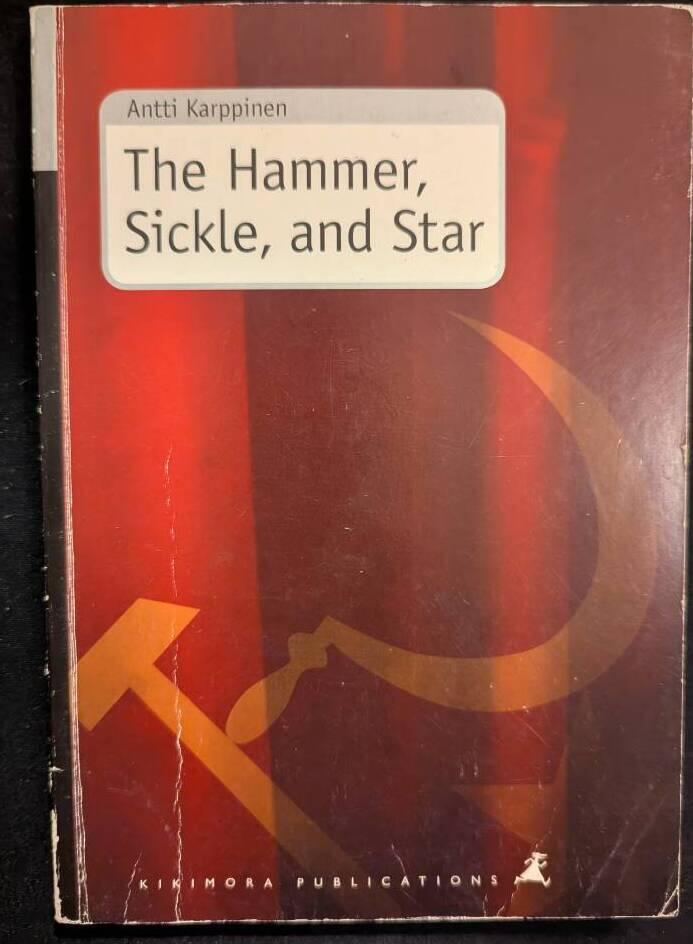

The hammer, sickle and star - following the idea of Russia
Häftad bok. 2006. 264 sidor.
Gott skick.
The Hammer, Sickle and Star: Following the Idea of Russia, a book by Ambassador Antti Karppinen was launched on 28 September on the premises of the Ministry for Foreign Affairs. Karppinen's book charts the ways in which the Russian identity and the idea of Russia have developed after the collapse of the Soviet Union.
The focus is on the views of Russian intelligentsia as espoused in the media. Key questions are: who are the Russians, where are they now, how did they end up in the current situation and what is to be done. Answers to these and other questions are sought in survey-like chapters which cover the years from 1995 to 2005, i.e. the latter half of the presidency of Boris Yeltsin and the ascendency and consolidation of Vladimir Putin. The key source material is composed of hundreds of articles and news items selected from 26 different newspapers, magazines and radio and television programmes. Karppinen stressed the fact that the authors have not presented their own views and judgments in the book, which contains only opinions expressed by the Russian intelligentsia in the Russian media.
At the book launch Karppinen and Dr. Ilmari Susiluoto sketched the development of the Russian power structure, the Russian idea and the intelligentsia over the last century. In authors' view, despite the occasional upheavals and revolutions, the Russian society and its power structure remains a pyramid, with a csar, a part secretary or a president at the top and the masses of the people at the bottom. As opposed to the West, a potent intelligentsia has also survived through the various changes and has provided a critical commentary on the injustices of the administration and has voiced the discontents of the people. In 1991, Russia was at the crossroads, with one road leading to democracy, and the other leading to autocracy. Nowadays, the authors maintain, the hierarchy is again closing into a pyramidal shape as the power of the president and the Kremlin is increasing.
In short discussion following the presentation the purges of the 1920s and 1930s and their effect on the Russian people and on the intelligentsia were briefly analysed. The issues concerning the liberation of the countryside in contemporary Russia were also raised. Finally it was noted that although president Putin has explicitly detached himself from any ideas of Russian-ness and similar ideological projects due to the destructive history of such projects, "the sovereign democracy" promoted by the Kremlin can be seen as an ideology that defines and legitimates the current Russian democracy, its deficiencies and the slowness of reform.
Antti Karppinen joined the Ministry for Foreign Affairs in 1955 when he assumed the first of his many postings in the Soviet Union and Russia. He ran, among other things, Finland's Consulate General in Leningrad during the years between 1973 and 1980 and was posted as the Finnish ambassador to now-former Czechoslovakia and West Germany.

Förlagsfakta
- ISBN
- 9789521032059
- Titel
- The hammer, sickle and star - following the idea of Russia
- Författare
- Karppinen, Antti
- Utgivningsår
- 2006
- Omfång
- 264 sidor
- Språk
- English