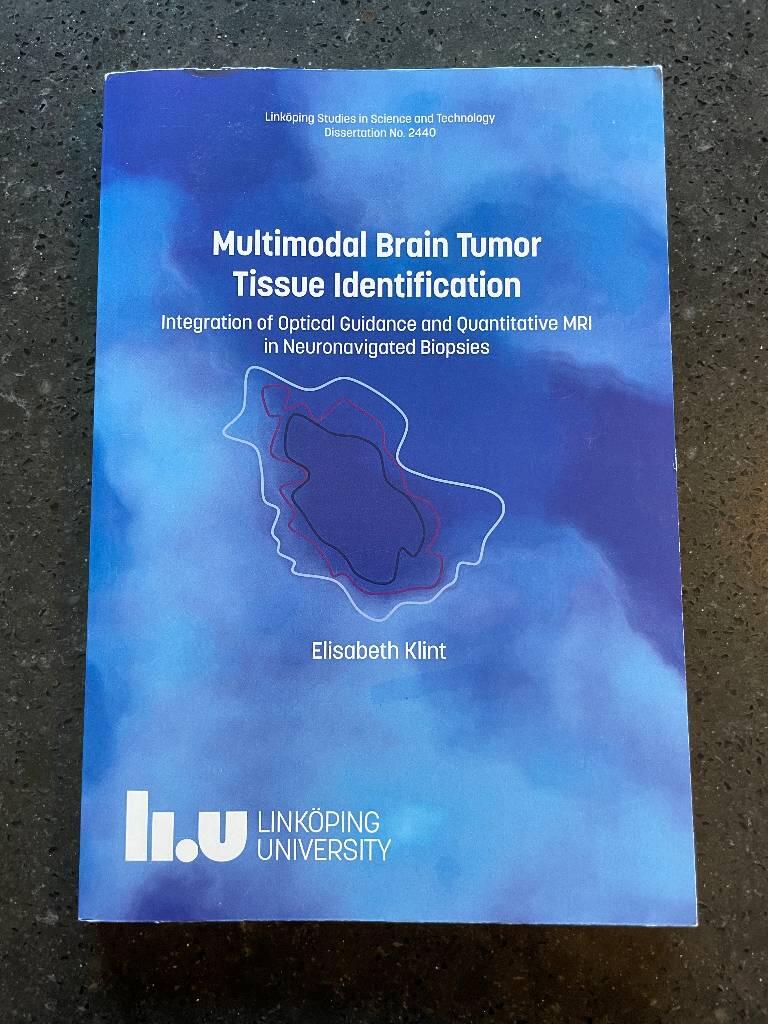
Multimodal brain tumor tissue identification
Häftad bok. Linköping University, Department of Biomedical Engineering. 2025. 100 sidor.
Mycket gott skick.
Inrikes enhetsfrakt Sverige: 62 SEK


Förlagsfakta
- ISBN
- 9789181180237
- Titel
- Multimodal brain tumor tissue identification - integration of optical guidance and quantitative MRI in neuronavigated biopsies
- Författare
- Klint, Elisabeth
- Förlag
- Linköping University, Department of Biomedical Engineering
- Utgivningsår
- 2025
- Omfång
- 100 sidor
- Bandtyp
- Häftad
- Språk
- English
- Baksidestext
- In neurosurgery, it is difficult to safely and reliably sample brain tumor tissue. Within the framework of this thesis, a method for optical guidance during navigated biopsy procedures was introduced. Furthermore, a workflow for multimodal analysis of tumor tissue was developed, comparing optical signals with intensities from magnetic resonance imaging (MRI) and neuropathological parameters. The five studies included in this thesis were carried out in close collaboration with the Department of Neurosurgery at Linköping University Hospital.??In Paper I, the optical technology is presented and experimentally evaluated. The system measures three signals: fluorescence, indicating high-grade tumor tissue; microcirculation, which detects blood vessels; and tissue light intensity, providing criteria for the type of tissue, such as gray or white matter. The parameters are displayed in real-time during surgery, where tumor tissue is identified as a fluorescence peak, and high, pulsatile blood flow could indicate vascular structures. In Paper II, the optical system was integrated into the frameless neuronavigation system and evaluated in a phantom before clinical measurements in three biopsy patients. Based on the integration, a multimodal workflow was introduced, including data processing, and registration to the neuronavigation coordinate system. In the clinical setting, good ability to identify tumor tissue and blood flow changes was confirmed.??Paper III presents a multiparametric analysis of data from 20 navigated biopsies where the optical technique was used. In each biopsy procedure, the biopsy needle was inserted into the brain in a stepwise manner with the optical probe inside. At each step, the optical signals were measured, the measurement position identified through the neuronavigation system, and direct feedback on tissue characteristics was received. The optical system offers an indication of where a diagnostic specimen can be sampled. Fluorescence peaks were found in high-grade tumors such as glioblastoma, astrocytoma, and lymphoma. Compared to the routine biopsy procedure, the procedure time could be shortened if fluorescence peaks are found.??To gain greater knowledge of the infiltrative zone between non-tumor and tumor tissue, the multimodal workflow was extended with two quantitative MRI (QMRI) methods: relaxometry (Paper IV) and diffusion MRI (dMRI) (Paper V). Relaxometry analyzes the biophysical basis of tissue relaxivity, e.g., before and after administration of a contrast medium. Along the biopsy trajectory, the difference in relaxivity was compared with the presence of fluorescence peaks, radiological definition of tumor, and neuropathological parameters. Increased relaxivity after contrast administration was not tumor-specific, however, the largest increases were found in tumor tissue. Diffusion MRI, or the study of the movement of water molecules in tissue, was compared in the biopsied volume and the contralateral normal-appearing white matter. Trends of lower anisotropy, kurtosis, and variance as well as increased diffusivity were found in patients with glioblastoma and astrocytoma. Furthermore, a subset of diffusion scalar maps was identified for future studies towards the clinical utility of dMRI for brain tumor patients.??In summary, probe-based optical guidance and a workflow for multimodal analysis, including QMRI data, was developed and integrated into the frameless brain tumor biopsy procedure. The techniques were combined for analysis with conventional MRI and neuropathological parameters. Quantitative MRI and optical guidance can provide further insights into tumor tissue identification and may, in extension, result in better patient care.
Linköping University, Department of Biomedical Engineering
9789181180237