
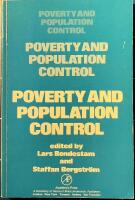
Powerty and Population Control
Häftad bok. Academic Press. 1980. 221 sidor.
Mycket gott skick.
Lite slitage på omslaget, se bild, men i mycket gott skick.
Baksidestext:
Blaming the poor for their poverty and procreation is a hallmark of most Western attitudes to "the population problem". This neo-Malthusian approach
characterizes the majority of analyses of the Third World's economic stagnation: poverty and underdevelopment are seen as a simple and inevitable result of over-population. Population control is accorded the highest priority as the remedy for impoverishment, and economic and social development are expected, ultimately, to follow in its wake.
At the World Population Conference in Bucharest, in 1974, a different opinion was launched which, in its conception, links the contributors to this book. In essence, reproduction is seen as a response to, and not a cause of, prevailing social and economic conditions. The contributors to this anthology of articles, writing since the Bucharest conference, share the view that there are factors other than population expansion that cause economic decay and slow social growth. Some aspects of this argument, expanded within the texts, refute the old and simplified Malthusian view; others are contentious in different ways. The point is made that population growth in underdeveloped countries, as in all countries, is the sum of the reproduction of-all individuals and this, in turn, is rational and determined by conditions under which people live.
It is argued, too, that overt or concealed interests in developed countries have nominated issues of overpopulation as priorities in combating underdevelopment, often as preconditions for international aid. All contributors to this book share a common belief in the right of every individual to determine his or her own fertility and to be given sufficient help to attain the family size and spacing they desire. Articles on population control in India, family planning in a Tamil village and the political ideology of population control indicate the scope of this book and the variety of interests to which it will appeal. Students and researchers, particularly in the fields of international politics, sociology, economics and community care, will find this a refreshing and stimulating book and there is much, too, to interest the anthropologist, the family planning worker and all who are involved in, or curious about, the Third World.
Printed in England
Academic Press, Inc. (London) Ltd.


![Teknik, samhälle, klasskamp : [en rapport från CMS' seminarium i Göteborg oktober 1978 med Charles Edquist ...]](https://dez1v4fbcawql.cloudfront.net/product/847/7728955/5b05c3505c2b5.jpg)