
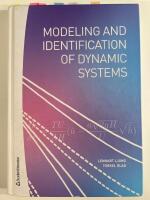
Modeling and identification of dynamic systems
Inbunden bok. Studentlitteratur AB. 1 uppl. 2016. 402 sidor.
Mycket gott skick. Skyddsomslag saknas.
Inrikes enhetsfrakt Sverige: 62 SEK

Förlagsfakta
- ISBN
- 9789144116884
- Titel
- Modeling and identification of dynamic systems
- Författare
- Ljung, Lennart
- Förlag
- Studentlitteratur AB
- Utgivningsår
- 2016
- Omfång
- 402 sidor
- Bandtyp
- Kartonnage
- Mått
- 155 x 166 mm
- Vikt
- 718 g
- Språk
- English
- Baksidestext
- Mathematical models of real life systems and processes are essential in today’s industrial work. To be able to construct such models is therefore a fundamental skill in modern engineering. This is a book about how to build models both from first principles in physics and from information in collected input and output measurements from the system.
Physical modeling is nowadays typically done by object oriented software, such as Modelica and Matlab’s Simscape. These techniques are described in the book, together with their theoretical and mathematical underlying principles. Domain-independent methods, such as following energy flows in bond graphs gives a useful background for understanding object oriented modeling. Both classical state-space models and general differential algebraic equations (DAE) are treated.
The book also gives a comprehensive treatment of system identification, that is, techniques to estimate mathematical models from measured system inputs and outputs. Both linear and nonlinear models are treated, including artificial neural networks. The text is related to the Swedish text Modellbygge och Simulering, Studentlitteratur, 2003. It also has some roots in the book Modeling of Dynamic Systems, Prentice Hall, 1994.
Studentlitteratur AB
1
9789144116884