
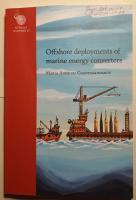
Offshore deployments of marine energy converters. (Diss.)
Häftad bok.
Gott skick. Uppsala 2019. 80 + (14) + 14 + 22 + (22) + 18 + 8 + (6) + (10) + (8) + 12 s. + tryckt omslag. Spikningsexemplar med hål i övre vänstra hörnet, samt ett par anteckningar på framomslaget. För övrigt i fint skick. Medförfattare: Irina Dolguntseva, Mats Leijon, Liselotte Ulvgård, Irina Temiz, Fémouit, Anke Bender, Jan Sundberg, Jens Engström, Tatiana Potapenko och Boel Ekergård. [31A]

Förlagsfakta
- ISBN
- 9789151306230
- Titel
- Offshore deployments of marine energy converters [Elektronisk resurs]
- Författare
- Chatzigiannakou, Maria Angeliki - Temiz, Irina - Leijon, Mats - Lewis, Tony - Uppsala universitet Teknisk-naturvetenskapliga vetenskapsområdet
- Utgivningsår
- 2019
- Språk
- English
- Baksidestext
- The depletion warning of non-renewable resources, such as gas, coal and oil, and the imminent effects of climate change turned the attention to clean and fossil fuel-free generated electricity. University research groups worldwide are studying solar, wind, geothermal, biomass and ocean energy harvesting. The focus of this thesis is the wave and marine current energy researched at the division of Electricity at Uppsala University (UU). The main drawbacks that hinder the commercialization of marine energy converter devices is a high installation, operation, maintenance and decommissioning cost. Furthermore, these processes are highly weather dependent and thus, can be time consuming beyond planning. In this thesis, an evaluation of the cost, time and safety efficiency of the devices’ offshore deployment (both wave and marine current), and a comparative evaluation regarding the safety in the use of divers and remotely operated vehicles (ROVs) are conducted. Moreover, a risk analysis study for a common deployment barge while installing an UU wave energy converter (WEC) is presented with the aim to investigate the failure of the crane hoisting system. The UU wave energy project have been initiated in 2001, and since then 14 WECs of various designs have been developed and deployed offshore, at the Lysekil research site (LRS), on the Swedish west coast and in Åland, Finland. The UU device is a point absorber with a linear generator power take off. It is secured on the seabed by a concrete gravity foundation. The absorbed wave energy is transmitted to shore through the marine substation (MS) where all the generators are interconnected. In 2008 an UU spin-off company, Seabased AB (SAB), was established and so far has developed and installed several WECs and two MSs, after the UU devices main principle. SAB deployments were conducted in Sotenäs, Sweden, at the Maren test site (MTS) in Norway; and in Ada Foah, Ghana. The active participation and the thorough study of the above deployments led to a cost, time and safety evaluation of the methods followed. Four main methods were identified and the most suitable one can be chosen depending on the deployment type, for example, for single or mass device deployment. The first UU full scale marine current energy converter (MCEC) was constructed in 2007 at the Ångström Laboratory and deployed at Söderfors, in the river Dalälven in March 2013. The UU turbine is of a vertical axis type and is connected to a directly driven permanent magnet synchronous generator of a low-speed. With this deployment as an example, four MCEC installation methods were proposed and evaluated in terms of cost and time efficiency. A comparative study on the use of divers and ROVs for the deployment and maintenance of WECs at the LRS has been carried out, showing the potential time and costs saved when using ROVs instead of divers in underwater operations. The main restrictions when using divers and ROVs were presented. Most importantly, the modelling introduced is generalized for most types of wave energy technologies, since it does not depend on the structure size or type. Finally, a table of safe launch operation of a WEC is presented. In this table the safe, restrictive and prohibitive sea states are found for a single WEC deployment, using a barge and a crane placed on it. The table can be utilized as a guidance for offshore operations safety and can be extended for a variety of device types and vessels.
Diss. (sammanfattning) Uppsala : Uppsala universitet, 2019
![Offshore deployments of marine energy converters [Elektronisk resurs]](https://dez1v4fbcawql.cloudfront.net/product/3595/9881622/5f9a96f375b93.jpg)