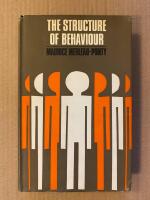
Structure of Behaviour (in English)
Inbunden bok. Methuen young books. 1965. 288 sidor.
Mycket gott skick. Skyddsomslag i mycket gott skick.
På engelska, översatt från franska.
Försiktigt läst, med lättare hanteringsslitage, som ett par stukade hörn.
Omslaget har lättare hanteringsslitage.
The Structure of Behaviour (French: La structure du comportement, 1942) by Maurice Merleau-Ponty, translated into English by Alden L. Fisher in 1963 (Beacon Press), is a foundational work of phenomenology that critiques traditional mind-body dualism by exploring behavior as unified, meaningful wholes (Gestalts) rather than mere reactions; it bridges Gestalt psychology, biology, and philosophy, arguing that consciousness and the world are intertwined through embodied perception, establishing the body as the primary medium of understanding meaning.
Key Concepts & Themes:
Gestalt Ontology: Behavior isn't reducible to parts; it's about unified, meaningful structures (Gestalts) where the whole is greater than the sum of its parts, like a melody.
Critique of Reductionism: Merleau-Ponty challenges pure physicalism (behavior as just physics) and pure vitalism (behavior as purely biological force), showing how meaning emerges at different levels of organization.
Embodied Consciousness: Consciousness isn't separate from the body; the body itself is intentional and forms meaning through its interaction with the world, adapting to situations.
Structure vs. Function: He distinguishes between the "ideal signification" (abstract meaning) and the "actual structure" (lived, concrete meaning) of behavior, emphasizing the latter.
From Lower to Higher Orders: The book moves from simple biological reflexes to complex human actions, showing how higher-level structures incorporate and reorganize lower-level ones, but aren't fully explained by them.
Significance:
Foundation for Phenomenology: It laid groundwork for his later famous works, Phenomenology of Perception, by grounding consciousness in the lived, physical world.
Impact on Psychology & Philosophy: It offered a rich alternative to behaviorism, influencing thinkers in philosophy, psychology, and beyond by integrating scientific findings with philosophical inquiry.
In essence, The Structure of Behaviour argues that the world and our bodies are already organized into meaningful structures, and our experience isn't about adding a detached mind to an inert body, but about being an integrated, sense-making part of the world from the start.