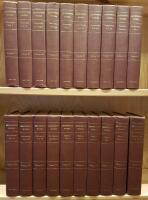
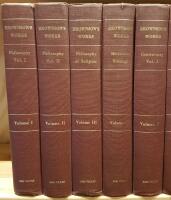

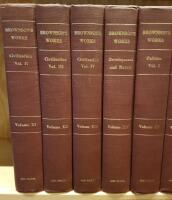
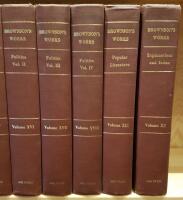
The Works of Orestes A. Brownson, Collected and Arranged by Henry F. Brownson Volume 1-20 (Complete set)
Inbunden bok. AMS Press Inc. New York. 1966. 11785 sidor.
Mycket gott skick.
A complete 20-volume hardcover set of "The Works of Orestes Brownson" collected and arranged by his son Henry F. Brownson in very good condition with some minor shelf wear. Please see attached pictures for a table of contents.
Orestes Augustus Brownson had few constants in his life, including reading, writing, politics, and publishing. Stockbridge, VT, farmers Sylvester Augustus Brownson and Relief Metcalf had 5 children, the youngest were twins, Orestes and Daphne. Four years after Sylvester’s 1805 death, Orestes was sent to a foster home in nearby Royalton. Considered a self-taught intellectual, young Brownson’s informal education began in foster care with the Bible, Homer, and Locke. When he was 14, the family reunited and moved to Ballston, NY, near the resort village of Ballston Spa.
Brownson’s introduction to the world of publishing and politics began when he was apprenticed to James Comstock, the owner, editor, and printer of the Independent American newspaper in Ballston Spa. This time with Comstock introduced the teenager to political and social ideas such as the biggest threats to democracy were money and privilege and that the upper class lived off the labor of the lower classes. These principles remained the basis of Brownson’s politics for several years and influenced his religious beliefs and approach to social reform.
He was well-versed in different branches of Christianity. His mother was a Universalist, his foster parents were Calvinist Congregationalists, he was baptized as Presbyterian, became a Unitarian minister, associated with Transcendentalists, and converted to Catholicism at 41. His religious and political opinions caused controversies that prompted Brownson to sever ties with churches and publications. Given Brownson’s background, it’s understandable why Octavius Brooks Frothingham describes Brownson as “a preacher of all orders in succession” in The History of Transcendentalism in New England (1880).
Brownson established himself as man of letters. He was, at times simultaneously, an editor, writer, publisher, literary and religious critic. By 1824 he was editor of Gospel Advocate and Impartial Investigator, a Universalist journal in which he criticizing organized faiths, religious mysticism, and his own religious doubts. Within 3 years, Brownson declared himself a Universalist, began exploring ministerial life, was ordained as a minister, and got married. During their 45 year marriage, Brownson and his wife, Sally (nee Healy) (1804-1872) had 8 children. Brownson was held in high regard by many European intellectuals and theologians, including Auguste Joseph Alphonse Gratry, who called Brownson "the keenest critic of the 19th century, an indomitable logician, a disinterested lover of truth, a sage, as sharp as Aristotle, as lofty as Plato." Lord Acton visited with Brownson and later wrote that "Intellectually, no American I have met comes near him."




![Den orättfärdiga rätten : en studie över Hegels rättfärdigande och marxismens kritik av den moderna rättsordningen = [Unjust justice] : [a study of Hegel's justification and the Marxist critique of the legal order]](https://dez1v4fbcawql.cloudfront.net/product/2546175/14034189/67963ee132a72.jpg)